Best Loyalty Software for Goodwill Organizations: 2027 Buyer’s Guide
Clutch publishes this guide and sells loyalty software to Goodwill organizations. We name competitors where public evidence exists and say where a simpler tool may fit better.
The short answer
Choose based on your POS, your store count and whether you need a rewards program or a customer engagement platform.
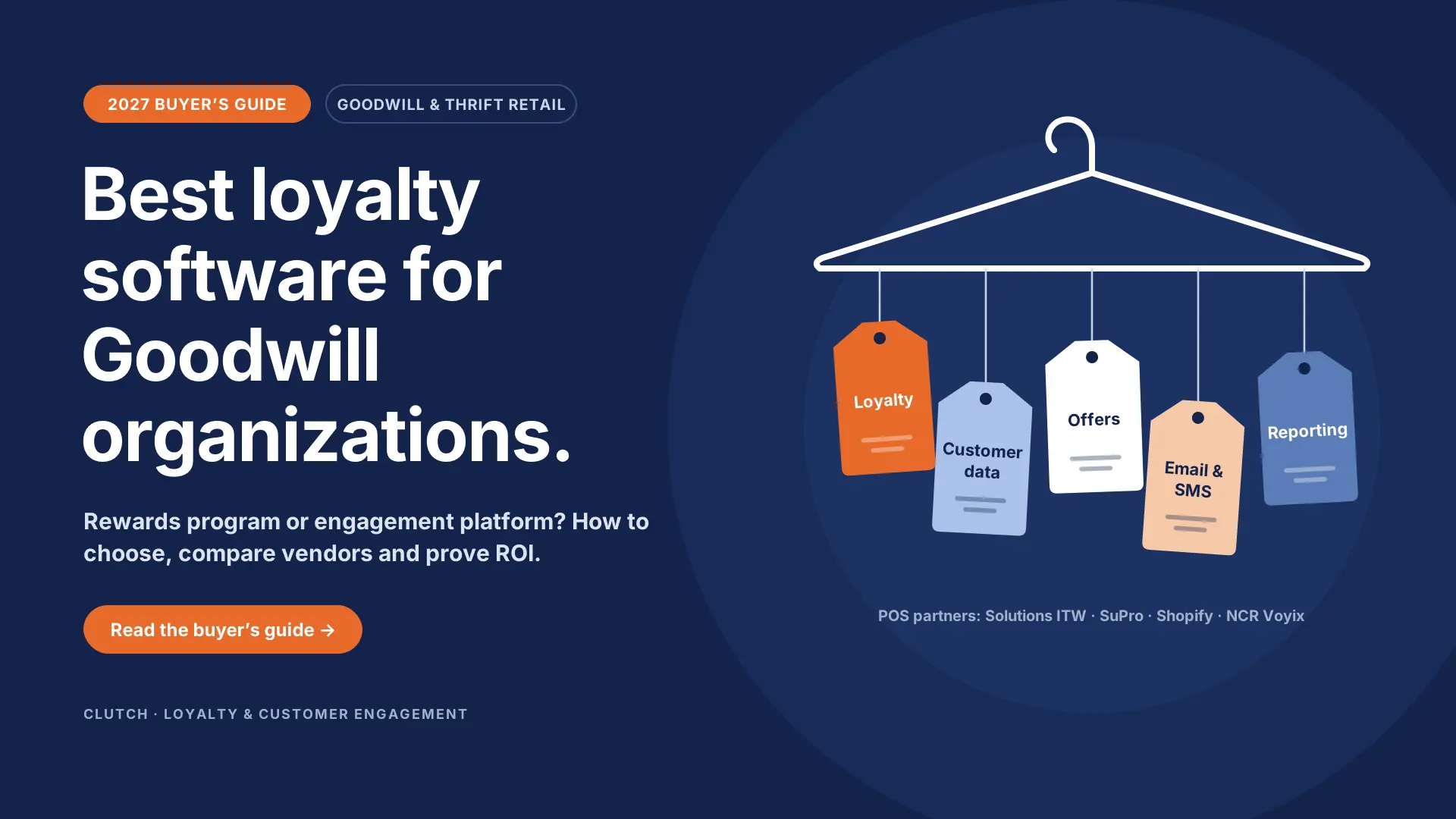
- You want customer data, targeted offers, automated email and SMS, and campaign reporting across many stores: evaluate an integrated platform such as Clutch, which works with multiple POS systems through its preferred partners Solutions ITW (as Solutions Loyalty powered by Clutch), SuPro, Shopify and NCR Voyix.
- You want a simple points or punch-card program launched quickly: evaluate a rewards-focused tool such as DataCandy, which publishes Goodwill case studies.
- You run a Datasym POS: evaluate bLoyal, which documents a Goodwill Youngstown deployment.
- You only need basic earn-and-redeem: check what your POS already includes first.
Key facts
- More than 150 locally led Goodwill organizations each choose their own technology (goodwill.org); we are not aware of a network-wide loyalty endorsement.
- Goodwill Industries of Middle Tennessee loyalty members spent 45% more per visit than nonmembers, and text messages generated $6.20 in attributed revenue per message versus $2.79 per email (case study).
- DataCandy reports Goodwill Industries of Chesapeake’s member sales grew from $2.8 million to $11.5 million in four years (case study).
- bLoyal connects Goodwill Youngstown’s 30+ locations through its existing Datasym POS (case study).
Rewards program or customer engagement platform?
The most important choice is which kind of system you need. Both reward repeat shoppers; they differ in what happens with the data.
A rewards program answers “how do we thank repeat shoppers?” An engagement platform answers “who are our shoppers, who is drifting away, and what brings them back?” Clutch is built as the second kind: loyalty management, a customer data platform, offer management, marketing orchestration and reporting in one system. If you need only the first, a simpler tool will usually cost less.
How the main options compare
Not sure which option fits your POS and goals? Request a free Goodwill Loyalty Readiness Assessment and get a written recommendation, including when Clutch is not the right fit. Request your free assessment
What the evidence shows
Goodwill Industries of Middle Tennessee runs True Blue Rewards across 30 stores. Its published case study reports that members spent 45% more per visit than nonmembers, purchases with a $5 reward redemption had a 72% higher average order value, and SMS produced $6.20 in attributed revenue per message versus $2.79 for email.
Reading results like these. Member-versus-nonmember gaps show association, not cause: frequent shoppers are more likely to join. Organizations that adopt loyalty may also be investing in marketing and stores. Ask any vendor for growth above a control group or peer benchmark.
What could these programs look like at your stores? The free Readiness Assessment includes a first-90-day campaign plan and a three-year cost worksheet sized to your store count. Request your free assessment
What makes Goodwill loyalty different
Every donated item is unique, so loyalty must reward the visit, not the product. Five patterns follow from that.
- Identification comes before discounts. Most Goodwill sales are anonymous before launch. Year one’s biggest gain is knowing who shops and how often.
- Rewards must coexist with existing promotions. Color-tag sales, senior days and outlet pricing interact with points. Clean exclusions keep cashiers from overriding the system.
- Enrollment depends on the cashier. Enrollment rates can vary widely between stores in the same network. Store-level reporting and coaching close that gap.
- Known non-members are an easy win. Shoppers identified by phone but not enrolled are often the cheapest group to convert.
- Traffic often grows before baskets do. If visits rise but average ticket does not, add basket-building offers rather than deeper discounts.
Requirements checklist
Ask each vendor to demonstrate every item on a register configured like yours.
Where Clutch fits, and where it does not
Clutch serves Goodwill organizations and other nonprofit thrift retailers.
“We were looking for an easy loyalty program for both our customers and our team, and Clutch covers all the bases. It allows us to collect purchasing data, build campaigns based on that data, and the new AI makes setting up campaigns a breeze.”— Colleen Porter, Goodwill of Greater Cleveland & East Central Ohio
Clutch fits best when you run many stores on a supported POS and want loyalty to drive segmentation, lifecycle campaigns and revenue reporting, or when a small marketing team needs campaigns templated or managed.
Clutch may not fit when you need only a simple points program, want the fastest, lowest-cost launch, or use a POS Clutch does not support. See Clutch for thrift and nonprofit retailers
Build or buy?
Neither is cheaper by default. Building can be right when your POS already handles earn-and-redeem and you have engineers to maintain integrations, SMS compliance and reporting for years. Buying shifts that maintenance to a vendor but adds license and messaging fees. Compare three-year totals using your own quotes and staff costs.
Three-year cost, in your own numbers:
- Build = initial build + 3 × (engineering staff cost + hosting + messaging + tools)
- Buy = implementation + 3 × (license + messaging + internal admin time)
Compare both against expected incremental gross profit. A common mistake is pricing the build and forgetting who maintains it in year three.
Five campaigns to launch first
None requires a new discount.
- New-member welcome: invite a second visit. Measure 30-day return rate.
- Close-to-reward nudge: message members near their next reward. Measure 14-day visits.
- Reward earned and expiring: confirm, then remind before expiration. Measure redemption.
- Lapsed-shopper win-back: target monthly shoppers absent 60 days. Measure against a holdout.
- Members-only sale day: turn an existing promotion into a member perk. Measure member visits versus a normal day.
How to measure ROI
Measure growth above what you would have achieved anyway. Goodwills without loyalty programs grow too, so crediting all growth to a program overstates its value.
Example (hypothetical). A 20-store Goodwill with $20 million in sales that verifies 2 points of growth above its benchmark adds $400,000 in sales. At a 40% gross margin, that is $160,000 in gross profit before program costs. Use your own margin.
Ten questions to ask every vendor
- Which Goodwills use your platform, and can we call two of similar size?
- Show lookup, earn, redeem and return live on our POS version.
- How do you handle color-tag, outlet and gift card exclusions?
- How long does enrollment take at the register?
- Can our team build segments and journeys without your help?
- How do you manage SMS consent and carrier registration?
- Which AI features are generally available today?
- Show a campaign report with a holdout group.
- What growth above a non-loyalty benchmark have your Goodwill customers achieved, and how was it measured?
- What are the full three-year costs: implementation, license, messaging and services?
Frequently asked questions
What is the best loyalty software for Goodwill organizations?
It depends on your POS, store count and goals. Integrated platforms such as Clutch suit multi-store Goodwills that want customer data and marketing automation; rewards-focused tools such as DataCandy suit fast, simple points programs; bLoyal documents a Goodwill deployment on Datasym. Basic needs may be met by your POS.
What results do Goodwill loyalty programs produce?
Published results are limited. Goodwill Industries of Middle Tennessee’s case study reports members spent 45% more per visit than nonmembers, and DataCandy reports Goodwill Industries of Chesapeake’s member sales grew from $2.8 million to $11.5 million in four years. Member-versus-nonmember gaps show association, not cause, so ask vendors for growth above a control group.
Does Goodwill Industries International endorse a loyalty vendor?
We are not aware of a network-wide loyalty endorsement; local organizations choose independently. The Goodwill National Cooperative Purchasing Program has named providers in some categories, such as Celerant for POS.
Which loyalty platforms integrate with Solutions ITW?
Clutch has a documented Solutions DGR integration, sold as Solutions Loyalty powered by Clutch; its other preferred POS partners are SuPro, Shopify and NCR Voyix. Solutions ITW also offers Club Goodwill. Ask other vendors for a live Solutions DGR demo.
Can Goodwill run a loyalty program without an app?
Yes. Most Goodwill programs identify shoppers by phone number at the register, with email, a card or a digital wallet pass as options.
Is it cheaper to build our own program?
It can be, especially for basic earn-and-redeem your POS already supports. As requirements grow to segmentation, SMS and attribution, so does ongoing engineering and compliance work. Compare three-year totals, including staff time.
How long does implementation take?
It depends on POS integration, data migration, store count and SMS carrier registration, which adds its own approval time. Ask each vendor for a plan and timeline built on your environment.
Can loyalty include donors?
Some Goodwills want to recognize donations alongside purchases. Ask vendors what is available today and what is still in development.
Does this guide apply to thrift stores that aren’t Goodwill?
Yes. Habitat for Humanity ReStores, hospice and charity shops, and independent thrift chains face the same challenges: unique inventory, mostly anonymous shoppers, and donors who are also customers. The requirements, campaigns and ROI method apply as written.
Prefer to see the platform first? Book a demo or see Goodwill customer results.
Sources
- Goodwill Industries International: About
- Clutch: Goodwill Industries of Middle Tennessee case study
- Clutch: Thrift & nonprofit retail
- Clutch: Solutions ITW partnership
- Solutions ITW: Solutions DGR 5.0
- Solutions ITW: Club Goodwill
- DataCandy: Goodwill Industries of Chesapeake
- Goodwill Industries of Alberta: GW Club
- bLoyal: Goodwill Youngstown
- Celerant: Goodwill NCPP partnership