Stop Sending Loyalty RFPs That Vendors Can Talk Around
Open-ended RFP questions invite open-ended answers. When a vendor says "yes, we support that," the real question is rarely whether the capability exists somewhere in the product. It's whether the capability is live in production today, configurable without custom development, proven with a reference you can call, backed by written evidence, and protected in the contract you're about to sign.
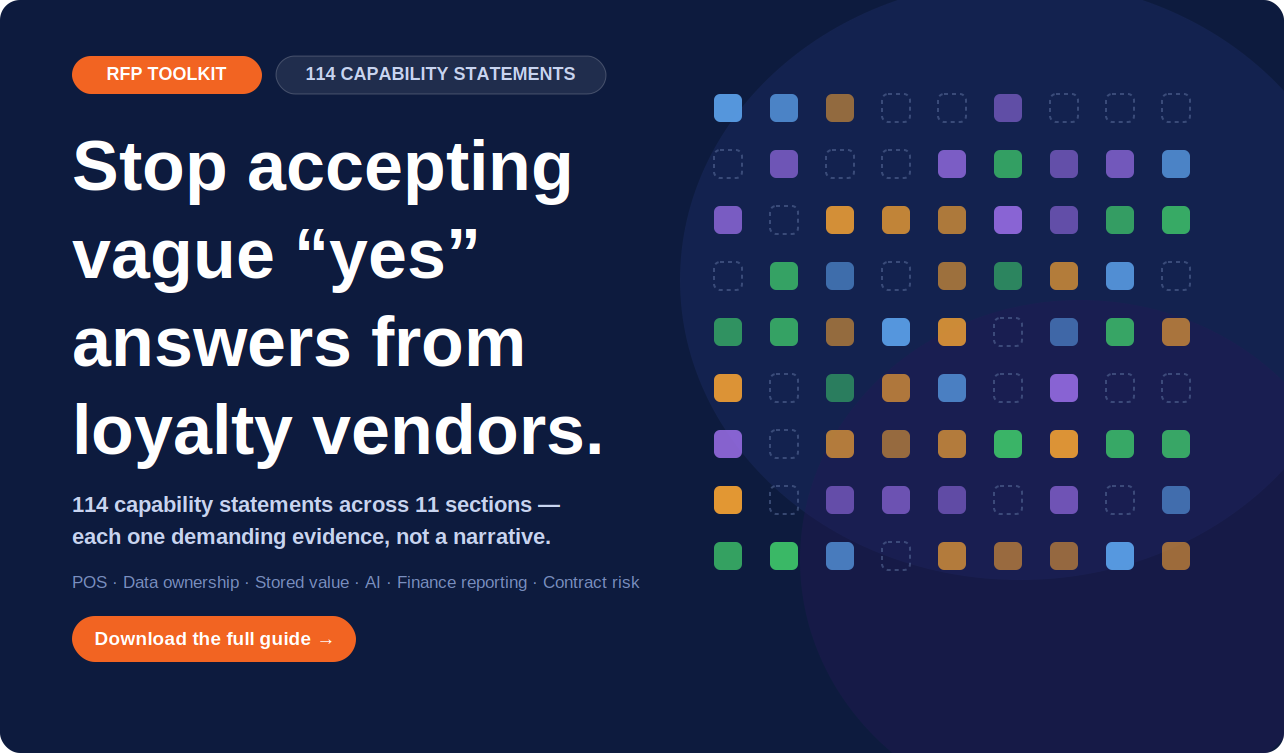
A "yes" with no documentation behind it isn't a finding — it's a placeholder. Clutch's Loyalty Platform RFP Evaluation Guide replaces open-ended questions with discrete capability statements that force a specific response: Fully Supported, Partially Supported, Custom Required, Roadmap, or Not Supported. Each one comes with a request for the evidence that backs it up.
114 Capability Statements Across 11 Evaluation Sections
The guide covers 114 capability statements across 11 evaluation sections. Technical Architecture and POS Integration looks at native POS certification, offline transaction handling, API-first architecture, SLA commitments on response time, and autoscaling under peak load. Platform Reliability and Infrastructure covers uptime SLAs and whether actual performance backs them up, disaster recovery testing cadence, backup architecture, and cloud hosting posture. Customer Data, CDP and First-Party Ownership addresses who legally owns the data, how identity resolution and profile merging work, and whether the platform meets SOC 2, PCI DSS, CCPA, and GDPR requirements.
Loyalty Program Management evaluates earn structure flexibility, business-user rule configuration, offer-stacking resolution logic, and support for multi-banner programs. Stored Value and Gift Card Management examines native versus bolt-on stored value architecture, real-time liability reporting, omnichannel redemption, fraud detection, and escheatment compliance. Offer Management, AI and Decisioning looks at real-time eligibility evaluation, production — not roadmap — next-best-offer and churn models, and whether AI is trained on shared or client-exclusive data.
Marketing Automation and Channel Delivery covers multi-step triggered campaigns, native A/B testing, cross-channel orchestration, and franchise-level template controls. Enrollment and Member Experience addresses POS enrollment speed, multi-channel enrollment options, retroactive history matching, and self-service member portals. Finance-Ready Reporting and ROI evaluates incremental lift reporting, discount efficiency, CFO-ready stored value liability reports, and native BI integrations. Implementation, Migration and Support covers implementation timelines, named delivery resources, migration history from competing platforms, and post-launch support SLAs. And Commercials, Contract and Vendor Risk addresses fee schedule transparency, auto-renewal notice windows, performance-based exit rights, change-of-control provisions, and data export rights at termination.
A Loyalty Platform Is Not Just a Points Engine
A modern loyalty platform sits at the center of customer identity, transaction data, POS integration, offer logic, rewards, communications, financial reporting, and stored value liability. A vendor that underperforms in any one of those areas doesn't just create a feature gap — it creates downstream risk across marketing, finance, IT, and legal.
Choosing the wrong platform is expensive to undo. Member data gets locked in proprietary formats. Stored value liability becomes difficult to reconcile. Implementation timelines slip past a full holiday season. Contract terms negotiated under time pressure become multi-year cost overruns. The cost of a flawed evaluation process shows up 12–24 months later, after the contract is signed and the switching costs are real.
A Sample of What's Inside
Here are ten of the 114 capability statements, pulled from across the guide. Under Technical Architecture, a Weight 3 item: the platform handles offline POS transactions — queuing, store-and-forward, and post-reconnect reconciliation — without loyalty data loss. Under Platform Reliability, also Weight 3: actual platform uptime over the past 12 months meets or exceeds the stated SLA. Under Customer Data and CDP, Weight 3: on contract termination, the client receives a full data export in a standard machine-readable format within 30 days at no additional fee.
Under Loyalty Program Management, Weight 3: the platform supports complex conditional earn logic — category-specific, daypart-specific, location-specific, and member-tier-specific rules simultaneously. Under Stored Value and Gift Cards, Weight 3: the platform tracks outstanding stored value liability in real time and produces a finance-ready liability report. Under Offer Management and AI, Weight 3: AI models are trained exclusively on the client's own data — not on shared data across the vendor's customer base.
Under Marketing Automation, Weight 3: the platform supports multi-step triggered campaigns — enrollment series, post-purchase flows, lapse triggers, win-back sequences — configurable by business users. Under Enrollment and Member Experience, Weight 3: a customer can complete full loyalty enrollment at a POS terminal in under 60 seconds without a smartphone. Under Finance-Ready Reporting, Weight 3: the platform produces a dedicated incremental lift report — isolating revenue attributable to the loyalty program from natural repeat-visit behavior. And under Commercials and Vendor Risk, Weight 3: the contract includes a change-of-control provision granting the client notification rights and a termination option if the vendor is acquired.
These are ten of the 114 statements in the full guide. Each one ships with a specific evidence request — the documentation, demo, or reference call needed to verify the response, not just accept it.
How the Scoring Works
Every capability statement gets a single response code, with no narrative answers and no partial credit for vague language. Fully Supported, or FS, means the capability is live in production today with no additional development required. Partially Supported, or PS, means the core capability exists but gaps or limitations apply. Configuration or Custom Required, or CR, means it requires configuration or custom development to deliver. On Roadmap, or RD, means it isn't available today but is planned for a future release. And Not Supported, or NS, means there's no current or planned support.
Each response code converts to a numeric score — FS equals five, PS equals three, CR equals two, RD equals one, and NS equals zero — which is then multiplied by a weight. A weight of three, Critical, is a must-have, where failure is disqualifying. A weight of two, Important, is a significant differentiator, where a gap creates real risk. A weight of one, Useful, is a nice-to-have, where a weak response lowers the score but doesn't eliminate the vendor.
The critical flag rule is straightforward: any Weight-3 item answered Not Supported or Custom Required without a credible, dated remediation plan is a red flag, regardless of the vendor's total score. Two or more such gaps should remove a vendor from the shortlist before the demo stage. A high aggregate score that's masking a critical gap is not a passing grade.
Download the Full Guide and Scorecard
Get all 114 capability statements, the complete weighted scoring model, the vendor scorecard, and section-by-section "Pro Tip" guidance for evaluation teams — formatted to send directly to vendors or to your own procurement and legal stakeholders.
Download the RFP Evaluation Guide
Bring the Guide to a Clutch Discovery Call
Bring this evaluation framework to a conversation with our team. We'll walk through the criteria with your stakeholders, section by section — including the questions most vendors try to talk around.