4 Gift Card Statistics—and What They Mean for Your Business
Gift cards are often treated as a seasonal line item: a display near the register, a small percentage of holiday sales, a box to check for the gifting occasion. That view understates what a modern gift card program actually does. For multi-location retail, restaurant, and ecommerce brands, gift cards and stored value function as a customer acquisition channel, a source of incremental spend, a cash flow advantage, and a bridge into loyalty and CRM data.
The numbers below explain why. Each statistic has been checked against its original source, and outdated or unsupported figures from earlier reporting on this topic have been corrected or replaced. Where a claim couldn't be verified, it was removed rather than repeated.
Gift cards represent a large and growing market
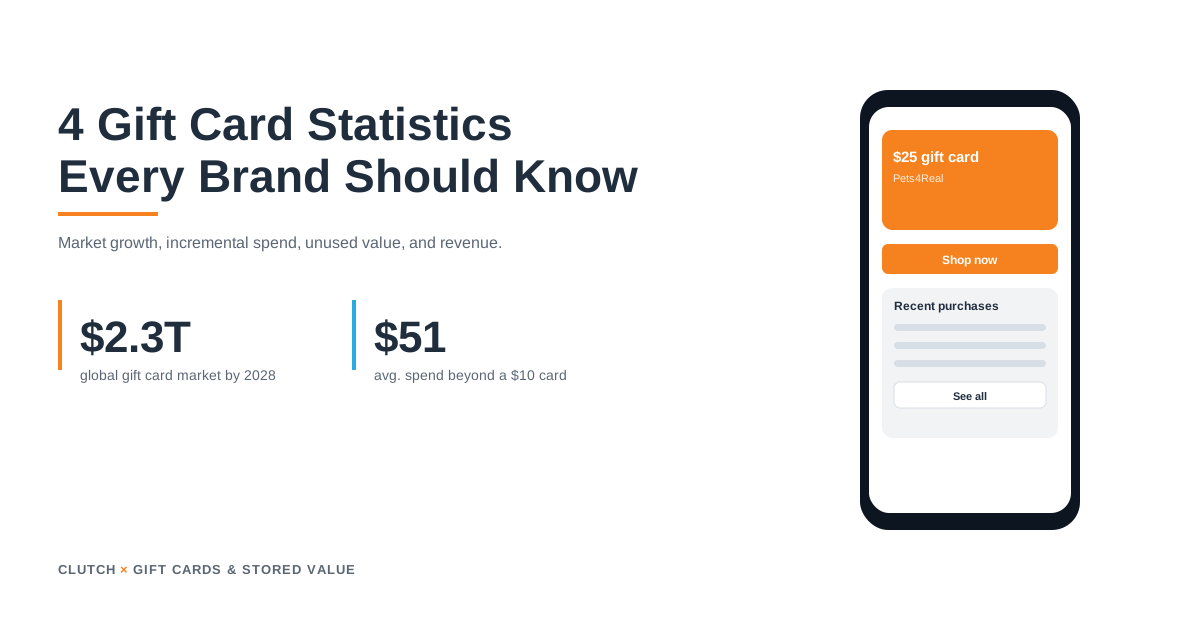
The global gift card market has been valued at roughly $1 trillion and is projected to grow toward the $2 trillion to $2.3 trillion range by the end of the decade, according to research cited by Blackhawk Network and Capital One Shopping. In the U.S. specifically, gift card sales have been estimated at more than $300 billion annually, with continued high-single-digit to double-digit annual growth forecast through 2029.
Digital delivery is a major driver of that growth. Blackhawk Network's research found that roughly 40% of the gift cards consumers planned to buy during the 2023 holiday season were expected to be eGifts rather than physical cards, and separate research from the company shows digital gift cards tend to carry higher average load values than physical ones, in part because shipping costs and in-store availability no longer limit the purchase.
For multi-location brands, this trend has two practical implications. First, mobile and ecommerce checkout flows need to support gift card purchase and redemption as a first-class option, not an afterthought. Second, a growing market means growing competition for gifting occasions. A brand without a modern, omnichannel gift card program is increasingly competing against brands that make it easy to buy, send, and redeem stored value from a phone.
Customers frequently spend beyond the gift card value
One of the more durable findings in stored value research is that gift cards drive spending beyond their own face value. In a 2022 U.S. consumer study, Blackhawk Network found that shoppers spend, on average, $51 more than the value of a $10 gift card, and up to $106 more than the value of a $500 card, with the size of the overspend shrinking as a percentage of card value as the denomination increases. The company's more recent 2026 gifting research confirms the pattern is still active: among consumers redeeming cards worth $50 or less, 74% said they were willing to spend more than the card's value.
This is sometimes referred to as "uplift" or incremental spend, and it's one of the strongest business cases for gift cards as a revenue tool—not because the card itself is profitable, but because redemption tends to produce a larger transaction than the card value alone would suggest. A $10 gift card that results in a $61 transaction represents roughly $51 in spending beyond the card's value, not a simple multiple of the sale price; framing it accurately matters for setting internal expectations about what a gift card program can realistically deliver.
Brands can encourage this behavior with merchandising near redemption points, bundled offers, and reminders about current promotions when a card balance is applied. The more important operational point is measurement: tracking the full transaction value associated with gift card redemption, not just the face value of cards sold, gives a more accurate picture of the program's actual contribution to revenue.
A meaningful amount of gift card value remains unused
Not every dollar loaded onto a gift card gets spent, and the scale is notable. According to 2026 research from Capital One Shopping, 43% of American adults report holding at least one unused gift card, with an average unused balance of $244 per person—a figure that rose more than 30% between 2023 and 2024. The most commonly cited reasons include forgetting about the card, losing it, or letting it expire before use.
It's worth separating two related but distinct concepts here. "Outstanding" stored value is simply the balance a customer hasn't yet redeemed; most of it will eventually be spent. "Breakage" is the accounting estimate of value that a company determines is unlikely to ever be redeemed. Based on public company disclosures, breakage rates recognized as revenue typically fall in a low single-digit percentage of gift card sales, though estimates vary by retailer and card type.
Unredeemed value should not be treated as free money to bank on. A customer who forgets they have a balance, or struggles to check it, is a customer having a worse experience with the brand than they should be—and that experience risk outweighs the short-term accounting benefit for most enterprise programs. It's also worth noting that unclaimed gift card balances are subject to escheatment and consumer protection rules that vary by state and, in some cases, by country; requirements around card expiration, dormancy fees, and reporting differ significantly by jurisdiction, so brands should consult qualified legal and accounting professionals rather than relying on general guidance when setting policy.
The more useful goal for most brands is reducing unnecessary breakage by making balances easy to check, sending balance reminders, and supporting redemption everywhere the customer shops—in stores, online, and in the app.
Gift cards can become a meaningful revenue channel
Gift card sales don't count as revenue at the moment of purchase; they're recorded as deferred revenue and recognized as customers redeem them. That distinction matters for how brands should think about gift cards as a "channel." Rather than a single, universal percentage of company revenue—a figure that varies too much by industry and card type to generalize responsibly—a more defensible way to see the scale of the opportunity is through aggregate consumer spending data.
The National Retail Federation found that gift cards ranked as the second-most popular gift for the 2025 holiday season, with U.S. consumers expected to spend $29 billion on gift cards and 43% of shoppers planning to buy at least one. That's a meaningful pool of prepaid spending flowing into retail, restaurant, and ecommerce brands every year, concentrated heavily around a handful of predictable, plannable occasions.
Corporate and bulk gifting, seasonal promotions, and bonus-card offers (for example, "buy $50, get a $10 card free") add to this channel outside the holidays. Getting the reporting and reconciliation right—separating gift card sales, redemption, and recognized revenue in financial reporting—is what turns this from a marketing tactic into something finance teams can plan around.
What these gift card statistics mean for your business
Individually, these numbers make the case for treating gift cards as a strategic program rather than a checkout add-on. Together, they point to a consistent set of priorities:
- Make gift cards available everywhere customers shop. Physical racks, ecommerce checkout, and mobile wallets should all support purchase and redemption.
- Make balances easy to check. Friction at the balance-lookup stage is a common reason cards go unused.
- Support redemption across every channel. A card purchased online should work in-store, and vice versa.
- Connect gift card activity to customer profiles where data practices and permissions allow. This turns a one-time purchase into a relationship you can build on.
- Pair gift cards with loyalty and marketing efforts rather than running them as a separate, disconnected program.
- Track the metrics that matter: activation, redemption, outstanding liability, incremental spend, and channel-level performance.
- Design promotions that are simple for customers and operationally manageable, especially across multiple locations or banners.
Physical versus digital gift cards
Neither format is a replacement for the other; most enterprise programs benefit from running both well.
The right approach is a unified stored value platform that treats physical and digital cards as two delivery formats for the same underlying balance, rather than two separate systems that need to be reconciled manually.
How gift cards and loyalty can work together
Gift cards and loyalty rewards solve different problems, but the best customer experiences connect them. Common use cases include:
- Customer acquisition: A gift card introduces a new customer to a brand they haven't tried, often through a friend or family member's recommendation.
- Rewarding loyal customers: Promotional stored value can function as a reward tier without changing a loyalty program's points structure.
- Service recovery: A stored value credit is a common way to make things right after a service issue, without the complexity of a refund.
- Driving a return visit: A card sent after a purchase, or as part of a win-back campaign, gives customers a reason to come back.
- Delivery through email or mobile wallet: Digital delivery makes gifting and rewarding faster and easier to track.
It's worth being precise here: stored value and loyalty points are different financial and program constructs, even though customers may experience them similarly. Gift card balances are typically a cash-equivalent liability with specific regulatory treatment; loyalty points are usually a promotional liability governed by the program's own terms. Brands that blend the two in customer-facing experiences still need to keep them separate in program design, accounting, and reporting—and should measure whether gift card recipients actually convert into repeat, loyalty-enrolled customers, since that conversion is often the real payoff of the acquisition use case.
What to look for in a gift card and stored value platform
Brands evaluating or modernizing a program should look for:
- Support for both physical and digital issuance
- True omnichannel redemption (in-store, ecommerce, mobile)
- Centralized balance management across formats and locations
- Integrations with existing ecommerce and point-of-sale systems
- Open APIs for custom workflows
- Fraud controls and transaction monitoring
- Reporting and reconciliation tools built for finance teams
- Customer service tools for balance and transaction support
- Simple, self-service balance lookup
- Support for promotional and bonus stored value
- Scalability across growing store counts or new markets
- Strong security practices, including PIN and verification options
- Mobile wallet compatibility
- Support for multiple brands, banners, or currencies, where relevant to the business
How Clutch supports modern stored value programs
Clutch's Gift Cards & Stored Value platform is built to help multi-location brands manage physical and digital stored value from a single system rather than a patchwork of point solutions. Brands can issue and redeem stored value across mobile, ecommerce, and point-of-sale channels, and consolidate credit across gift cards, merchandise credit, and promotional credit into one customer-facing balance.
Because Clutch's stored value tools sit on the same platform as its loyalty management and customer data tools, gift card activity can connect to a broader customer profile rather than living in an isolated system—supporting the kind of coordinated gift card and loyalty strategy described above. The platform also includes activity monitoring and fraud detection, PIN and verification options for added security, and a network of integration partners to fit into brands' existing commerce stack. For programs operating internationally, Clutch supports fixed-fee pricing to help simplify cross-border stored value management.
The result is a program brands can actually report on: clearer visibility into issuance, redemption, and outstanding liability, without needing to reconcile data across disconnected systems.
Frequently asked questions
What is a stored value program?
A stored value program lets customers load or receive prepaid balances—gift cards, merchandise credit, or promotional credit—that they can redeem later for goods or services. Unlike loyalty points, stored value typically functions as a cash-equivalent liability on a company's books. A well-run program supports purchase, gifting, and redemption across every channel a brand sells through, and gives both the business and the customer clear visibility into balances.
Are gift cards considered revenue when they are sold?
Not immediately. When a customer buys a gift card, the business records the sale as deferred revenue, since it has an outstanding obligation to provide goods or services later. Revenue is recognized when the card is redeemed, or, in some cases, when the balance is determined unlikely to ever be redeemed (breakage). This distinction matters for financial reporting and is why gift card sales and gift card revenue are not the same number.
Why do customers spend more than the value of a gift card?
Research shows gift card holders frequently spend beyond the card's face value, particularly on lower-denomination cards. Reasons include lower price sensitivity when using "found" money, a desire to round out a purchase, or simply finding an item that costs slightly more than the balance. Businesses should track full transaction value at redemption, not just the card's face value, to understand the real revenue impact.
What is gift card breakage?
Breakage is the accounting estimate of gift card value that a company determines is unlikely to ever be redeemed by customers. It's distinct from a card's currently outstanding balance, which is simply unspent value that hasn't been used yet. Breakage is recognized as revenue under specific accounting rules, and rates vary significantly by retailer, card type, and jurisdiction. It should be estimated carefully rather than assumed.
What is the difference between a gift card and a loyalty reward?
A gift card is typically a cash-equivalent prepaid balance, often purchased or given, that functions similarly to currency for a specific brand. A loyalty reward is usually earned through purchases or engagement and governed by a program's own rules and terms, without the same cash-equivalent treatment. Brands often use both together, but they are different financial instruments and should be tracked separately.
Can physical and digital gift cards use the same balance system?
Yes, and for enterprise brands, this is the recommended approach. A unified stored value platform allows a single balance to be checked, loaded, or redeemed whether the customer has a physical card or a digital code, avoiding the reconciliation problems that come with running separate systems for each format.
What metrics should businesses track for a gift card program?
Key metrics include activation volume, redemption rate, outstanding liability, incremental spend at redemption, breakage rate, and performance by channel (in-store, ecommerce, mobile). Tracking these consistently gives finance and marketing teams a shared, accurate view of how the program is actually performing, rather than relying on gift card sales alone.