Gift Card Management Explained: Processing, Stored Value, and Distribution
A gift card is a promise of a future visit. A recipient who has never shopped with a brand arrives with value to spend. A customer who returns an item and leaves with store credit has a reason to come back. A regular who keeps a balance in the brand's app has one more reason to choose it next time. Managed well, stored value creates repeat visits, stronger customer relationships, and more opportunities to sell.
Capturing that opportunity depends on consistency. A gift card bought online should work in store, credit should be easy to find and redeem, and Finance should be able to reconcile all of it. As brands add channels and programs, those expectations depend on a reliable processing foundation.
Gift card management is the work of running a program in which customers hold value they can spend with a brand later: the record of every balance and transaction, plus sales, distribution, fulfillment, financial reporting, and customer service.
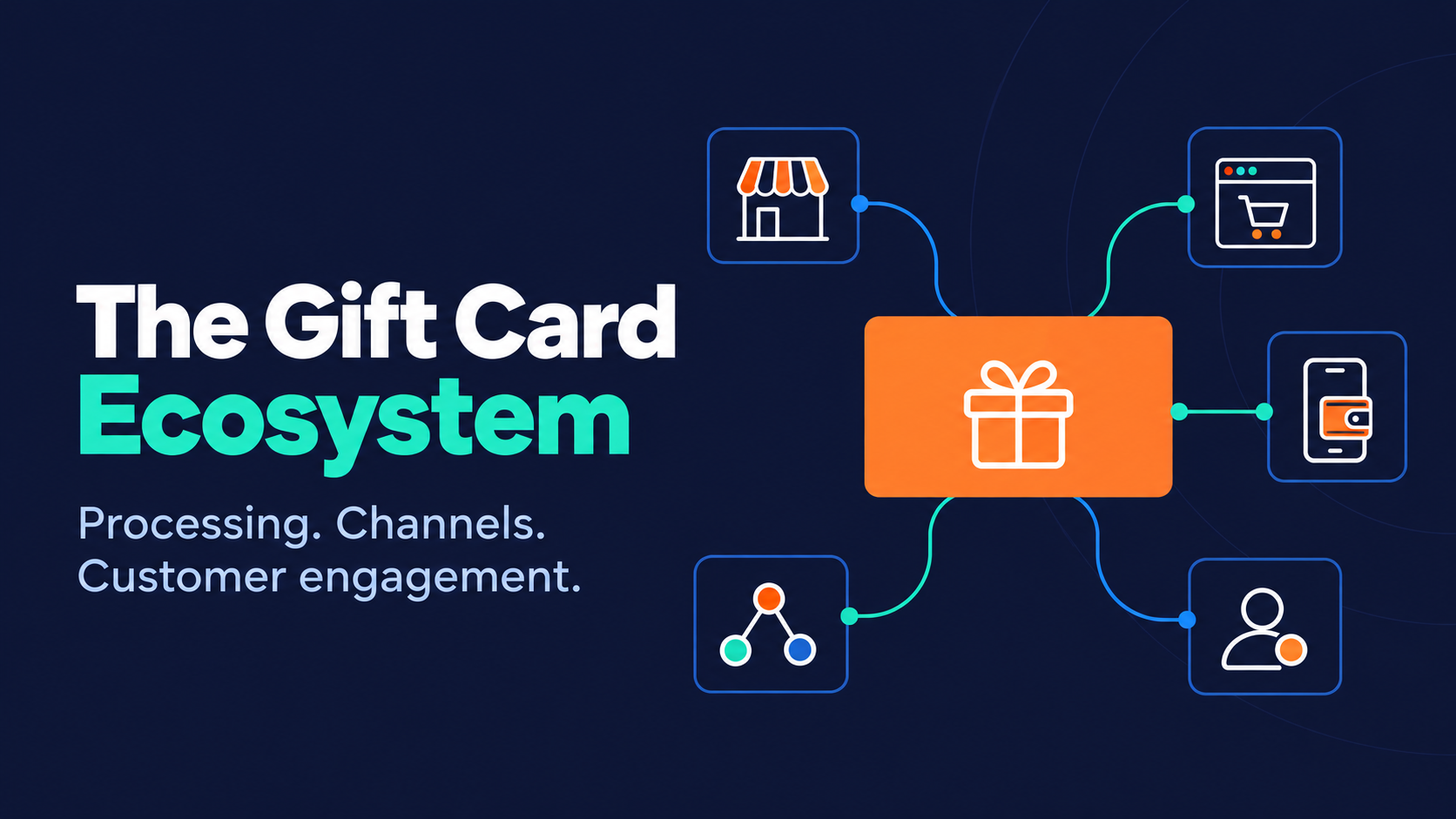
Clutch provides the gift card and stored value processing foundation that maintains those balances and transactions. Brands build on it by connecting channels, adding new uses of stored value, engaging customers, and bringing in partners for the jobs they choose not to run themselves.
What counts as stored value
Stored value is a balance a customer can spend with a brand. Gift cards are the most familiar form. Six common uses:
- Purchased gift cards. A customer pays $50 for a card to give to a friend.
- Merchandise credit. A shopper returns an item and receives store credit.
- Trade-in and resale credit. A customer trades in an eligible used item, or sells it through a resale program, and receives brand credit.
- Service recovery credit. A restaurant credits a guest $15 after a delayed order.
- Promotional bonus value. A guest who buys $100 in gift cards receives a $20 bonus card.
- Reloadable balances. A regular customer loads $50 in the brand's app and pays from that balance.
These uses can share infrastructure while retaining distinct program rules, funding sources, and reporting. Purchased value is money a customer paid; service recovery and promotional value are funded by the brand.
What a gift card processor does
A gift card processor, or stored value platform, is the system of record for balances. It handles activation, loading, redemption, balance inquiries, transaction history, and adjustments such as refunds and reversals.
A customer buys a $100 gift card and later spends $35. The processor activates the card at $100, authorizes the $35 redemption, records both events, and updates the available balance to $65.
Stored value processing and collecting the buyer's payment are distinct functions, even when one provider offers both.
Why connected channels matter
When the POS, branded ecommerce site, mobile app, and kiosk all read and write the same balance, a card bought online can be redeemed in a store, and a balance check gives the same answer everywhere. When channels keep separate records, customers get inconsistent answers and Finance gets numbers that are hard to reconcile.
When a dedicated stored value platform makes sense
Many brands start with gift card features built into a POS or ecommerce platform. A dedicated stored value platform becomes valuable when the program needs to:
- Manage value across systems: stores, ecommerce, apps, kiosks, and external channels drawing on one balance.
- Run multiple programs: gift cards, merchandise credit, trade-in credit, comps, and promotions with distinct rules.
- Reconcile across locations or entities: corporate and franchise locations, or several brands under one parent.
- Connect value to customers: link balances to profiles, loyalty, and relevant communications.
- Support partners: work with distributors, program managers, and resale platforms around a single record of value.
If several of these apply, the processing foundation is worth choosing deliberately.
Apple Wallet and Google Wallet passes: make stored value easier to access
A wallet pass puts a gift card or credit in Apple Wallet or Google Wallet, so customers can carry it on their phone and present it at checkout instead of searching for a plastic card or an old email. Both Apple and Google offer pass types for gift cards that can display a balance.
The pass presents the credential; the processing engine still maintains the balance. A gift recipient adds the pass to their phone, the cashier scans it at checkout, and the redemption updates the same balance the customer would see online or in the brand's app.
First-party sales and third-party distribution
The channel is defined by who sells the card to the buyer, not whose software runs the checkout.
First-party gift card salesThird-party gift card distributionWhere the sale occursThe brand's stores, website, app, or direct sales team, including vendor-hosted storefrontsOutside retailers, marketplaces, incentive platforms, reward catalogsCustomer relationship and dataBrand can capture purchaser details and sets the experienceSeller owns the purchase; the brand may receive little purchaser dataFees, proceeds, and timingPayment processing and platform costsCommissions or discounts reduce net proceeds; funds arrive on the distributor's settlement schedule
Both channels can connect to the same processing foundation: a card sold on a grocery rack is activated through the distributor's network, and a later redemption in the brand's store updates the same balance. External distribution reaches new buyers, though network access does not guarantee placement in a particular retailer or catalog.
B2B describes the buyer, not the channel. A company buying 500 cards directly from a restaurant brand is a first-party B2B sale; the same purchase through an incentive marketplace is third-party B2B.
Who does what in a gift card program
A program involves several distinct roles. One company can hold several, or each can sit with a different party.
RoleWhat it doesTypically provided byStored value processorMaintains balances and authorizes activation, loading, and redemptionClutchIssuerIssues the card and stands behind the balanceThe brand, or a program managerProgram managerCoordinates defined responsibilities such as issuance, fulfillment, and servicePartners such as TOTUSDistributorSells cards through outside retail, marketplace, and B2B channelsPartners such as Blackhawk Network and InComm PaymentsBranded gifting commerceRuns branded storefronts and B2B giftingClutch-hosted eGift, or partners such as eGifterBuyer payment processor and merchant of recordCollects the buyer's payment and is responsible for that transactionThe brand's payment provider, or the seller in third-party channelsFulfillment providerProduces and delivers physical cardsCard manufacturers or a program manager
Clutch provides gift card and stored value processing connected to customer data, loyalty, offers, and marketing, and works with a partner ecosystem that includes TOTUS, Blackhawk Network, InComm Payments, and eGifter. Clutch provides processing for TOTUS programs, whose issuance, compliance, fulfillment, and customer service let brands outsource program management. It also provides back-end processing for Blackhawk Network's gift card distribution programs. InComm extends retail distribution and incentive reach, and eGifter adds white-label storefronts, B2B tools, and appeasement solutions.
Building on Clutch: a flexible path
A program starts with a processing foundation and adds capabilities as goals require; many brands launch several at once:
- Establish the foundation: Clutch processing, launch channels, program rules, and reporting.
- Expand how value is used: digital gifting, wallet passes, and the stored value programs below.
- Build relationships: connect registered balances to customer profiles, loyalty, and relevant communications.
- Extend distribution: add external retail, marketplace, and corporate reward channels where the economics make sense.
- Add operational support: bring in program management, fulfillment, or customer service partners where internal resources are limited.
What a specific program can do depends on its setup. POS, ecommerce, and app integrations; wallet pass features such as automatic balance updates; connections with partners and resale platforms; and the scope of settlement services are all defined when the program is scoped. Clutch lists its available integrations as a starting point.
Expanding beyond gifting
The same foundation that runs gift cards can run other kinds of stored value, each as its own program.
Merchandise credit
Merchandise credit is issued following a return. Issued on the same platform as gift cards, it can be tracked through redemption alongside every other balance, and it gives the customer a clear reason to return.
Trade-in and resale credit
Trade-in and resale credit turns eligible products into future spending. It looks like merchandise credit but follows different rules. Trade-in credit is issued for an eligible item, typically after inspection or acceptance under the program's rules. Resale earnings are earned when an item sells and may be paid as cash or brand credit, depending on the program.
Resale and trade-in platforms determine eligibility, evaluate products, and calculate credit. Archive, for example, supports in-store and online trade-in for store credit, and ThredUp's Resale-as-a-Service includes a Clean Out program that exchanges used clothing for credit with a participating brand. These are market examples rather than Clutch integrations.
In an illustrative Clutch-based architecture, a customer trades in an eligible jacket and receives $40 in brand credit. The trade-in platform sets the value and passes the approved amount to Clutch, which records it as trade-in credit. The customer adds the credit to their phone's wallet, later redeems $25, and Clutch records a remaining balance of $15.
Service recovery, promotional, and reloadable value
Consider a restaurant group. When an order runs late, a manager issues a $15 service recovery credit, and the team can track issuance and redemption by location. During the holidays, the group offers a $20 bonus card with every $100 in gift cards, under its own terms. Regular guests load $50 in the group's app and pay from that balance each visit. All three run on the same foundation as the group's gift cards.
Connecting value to customer relationships
When recipients register their cards, a brand can connect those balances to its customer data platform, loyalty program, and marketing orchestration, where those Clutch modules are part of the program. That turns anonymous balances into known customers the brand can welcome back. Two cautions: gift card sales are not the same as incremental revenue, so measure results in your own data; and buying or receiving a gift card is not marketing consent.
Finance and operational ownership
Software supports these responsibilities but does not resolve them on its own.
Outstanding balances. Unredeemed value generally represents an obligation to customers. Finance needs reporting that ties balances to cards, programs, channels, and locations.
Reconciliation and settlement. Stored value activity should reconcile with payment processing, distributor remittances, and the general ledger, with each value type reported separately. Clutch describes support for settlement between multiple locations with location-level reporting; define whether you need settlement reporting, calculation, or funds movement, and how often.
Service and fraud. Assign in writing who answers customers and who absorbs fraud losses and chargebacks.
Issuance and compliance. Card terms and applicable federal and state requirements, which can include unclaimed property rules, sit with the issuer and should be reviewed with counsel and auditors. A program manager can take on defined responsibilities, but outsourcing does not remove every obligation.
Buyer checklist: questions to ask before choosing a solution
- Which stored value programs will we run at launch, and which may we add later?
- Which sales and redemption channels, including wallet passes, must be live on day one?
- Who is the issuer, and who is merchant of record in each channel?
- How will Finance reconcile balances, fees, liability, and cross-location settlement?
- Who handles customer service, fraud losses, and chargebacks?
- What customer data will we receive, how will we capture consent, and what can we export if we leave?
Frequently asked questions
Do brands need a program manager?
Not necessarily. Brands with staff for accounting, compliance, fulfillment, and customer service often run programs themselves on a processing platform. A program manager can take on defined responsibilities when internal resources are limited; the contract determines which duties shift.
What should a brand consider when replacing its gift card processor?
Plan how existing balances migrate and whether current card numbers keep working. Test every channel integration before cutover, agree how reconciliation will be verified, and review data export rights and exit terms in the new contract.
Can one gift card program handle corporate bulk orders?
Yes. Businesses can buy cards directly from the brand for employee or customer gifts, which is a first-party B2B sale, or through incentive platforms and reward catalogs, which is third-party distribution. Both can run on the same processing foundation, with different pricing, fulfillment, and settlement arrangements.
How should a brand measure a gift card program?
Look beyond gift card sales. Track net proceeds by channel, redemption rates and timing, outstanding balances, and new versus returning customers where they can be identified. Report each value type separately, and compare results against the brand's own baseline rather than treating sales as incremental revenue.
Map your gift card and stored value program with Clutch
Build a gift card program that works across channels, supports your finance team, and creates more opportunities to bring customers back. In a working session, Clutch helps your team define:
- Priority use cases, such as gift cards plus merchandise credit
- Launch channels and the integration requirements for each
- Program rules and reporting needs by value type
- Responsibilities your team will retain
- Complementary services or partners you may need
- Opportunities for future expansion
Request a working session with Clutch to map your program.